

In short: Depending on the burner, an ethanol fireplace consumes approximately 0.2 to 0.5 liters of bioethanol per hour. It provides a real flame effect without a chimney, but is not a substitute for heating. It is important to ventilate regularly, refill only when the combustion chamber is cold, and extinguish using the extinguishing cover.
What is bioethanol?
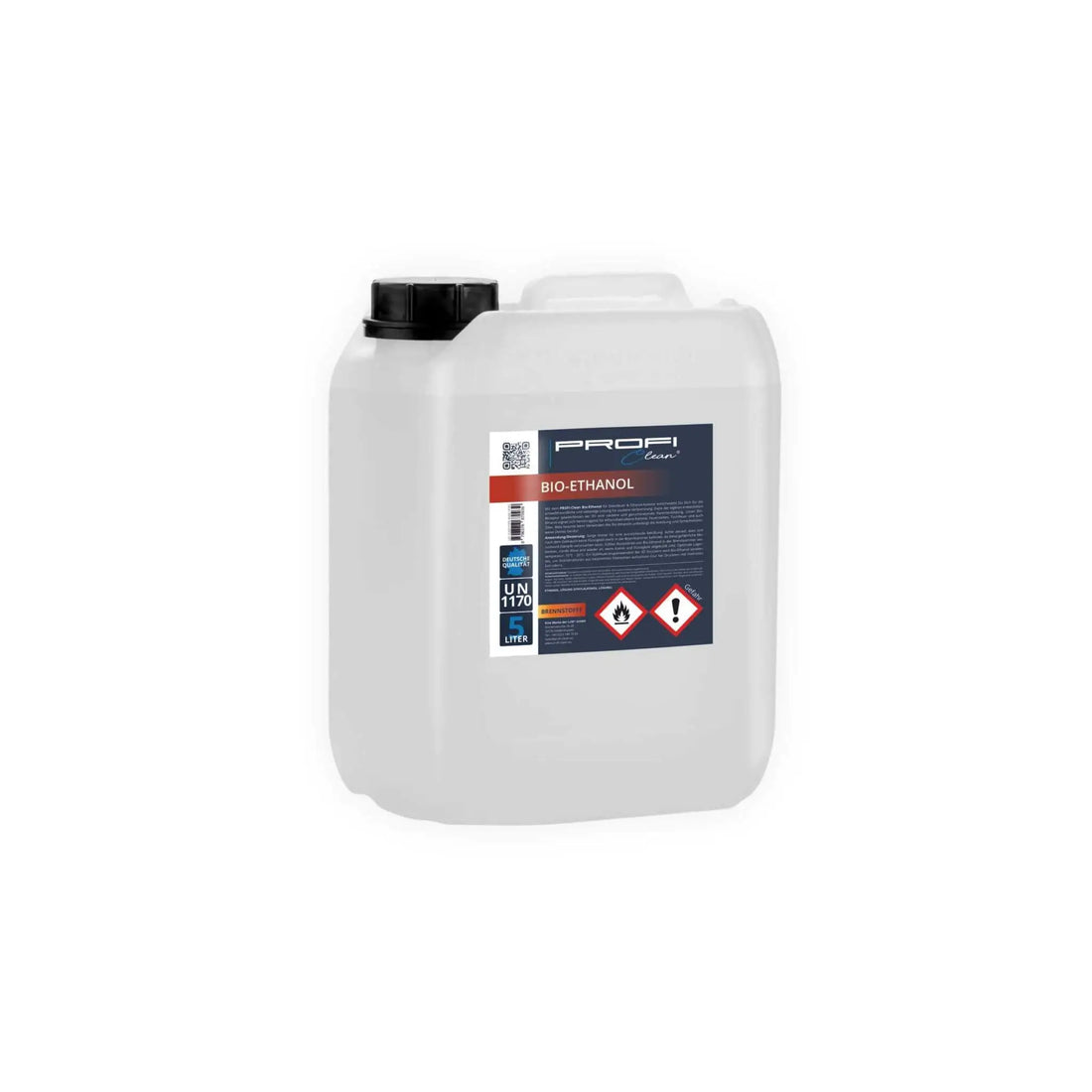
Bioethanol is alcohol produced from plant-based raw materials such as grain or sugarcane. As a fuel for fireplaces, it is denatured, meaning it is made undrinkable. PROFI-Clean Bioethanol has a concentration of 96.6% and is intended for ethanol fireplaces, tabletop fires, and combustion chambers approved for bioethanol.
How much does an ethanol fireplace consume?
Consumption depends primarily on the size of the burner and the set flame height. As a guideline:
| Device | Consumption per hour | Burn time with 1 liter |
|---|---|---|
| Small tabletop fireplace | approx. 0.2 l | approx. 5 hours |
| Medium wall-mounted or freestanding fireplace | approx. 0.3 to 0.4 l | approx. 2.5 to 3.5 hours |
| Large burner | up to approx. 0.5 l | approx. 2 hours |
The exact consumption is specified by the manufacturer of your fireplace. You can also measure it yourself: fill the burner with a known quantity and time how long it burns.
How much does an evening by the ethanol fireplace cost?
For example: If your fireplace burns for three hours at 0.3 liters per hour, you will need 0.9 liters. In a 4-pack of 5-liter canisters, the price per liter at PROFI-Clean is around €2.28 – so an evening will cost you about €2. With a single 1-liter bottle (€6.69), it would be around three times as much. (Prices as of November 2026; you can see the current base price in the shop.)
Can I heat with an ethanol fireplace?
An ethanol fireplace gives off noticeable heat, but is primarily intended for decoration and creating ambiance. Because you must ventilate regularly, some of the heat is lost. It is not suitable as a substitute for heating. If you want to heat a room specifically with liquid fuel, a petroleum heater is the more suitable solution.
Ventilation: How often is necessary?
Carbon dioxide and water vapor are produced during combustion, and the flame also consumes oxygen. Therefore:
- Adhere to the manufacturer's minimum room size – large burners do not belong in small rooms.
- Ventilate regularly with cross-ventilation during operation.
- Ventilate the room thoroughly after extinguishing.
- Do not operate in bedrooms or small, enclosed rooms.
Lighting, refilling, extinguishing
- Preparation: Is the combustion chamber clean and cold? Are the safety devices intact? Are flammable objects far enough away?
- Filling: Pour the bioethanol in using a funnel, not above the fill line. Wipe up spills immediately.
- Lighting: Use a long-reach lighter or long matches, keeping your face and hands at a distance.
- Operation: Never leave the fire unattended, and keep children and pets away.
- Extinguishing: Use the extinguishing cover or slide. Do not blow it out or pour water into it.
- Refilling: Only when the combustion chamber has cooled down completely – never into a burning or hot chamber.
In case of emergency, a fire blanket or suitable fire extinguisher should be kept within easy reach.
Storing bioethanol correctly
Bioethanol is highly flammable. Store it tightly sealed in a cool, well-ventilated place, away from ignition sources and out of reach of children – not directly next to the fireplace. It can be used for a long time in the original canister, provided it remains tightly sealed.
Common mistakes
- Refilling a still-hot combustion chamber
- Using a burner that is too large for a small room
- Ventilating too infrequently
- Using other fuels such as methylated spirits with additives, lamp oil, or petroleum in the ethanol fireplace
- Using bioethanol in a petroleum heater or to light a barbecue
Order PROFI-Clean Bioethanol 96.6% now
Frequently asked questions
How much bioethanol does a fireplace consume per hour?
Depending on the burner and flame height, approximately 0.2 to 0.5 liters. With 1 liter, you will get around 2 to 5 hours.
Is bioethanol dangerous in the living room?
Not if used correctly. Adhere to the minimum room size, ventilate regularly, refill only when the combustion chamber is cold, and never leave the fire unattended.
Why does my ethanol fireplace smell?
A slight smell when lighting and extinguishing is normal. A stronger smell is often caused by a dirty burner, an incorrectly set flame, or insufficient fresh air.
Which package size is the most economical?
The 4-pack of 5-liter canisters has the lowest price per liter. If you only use the fireplace occasionally, 5 liters will last you well through the winter.